
QIWU 02 · PROBABILITY · LONG-HORIZON SIMULATION
One trade is not a system.
Place a strategy inside a long sequence. Observe how win rate, payoff ratio, position size, result order, drawdown and compounding shape the path.
Public preview available|Formal packages and paid services have not launched
Sequence before certaintySurvival before growthSimulation, not prediction

EDGEMethod
SEQUENCEProbability
SURVIVALRisk
Interactive probability experiment
Same loss. Different edge. A very different path.
Change the win rate, number of trades and risk-to-reward ratio for two strategies. Then reshuffle the order of wins and losses to see why expectancy and sequence risk must be studied together.
EXPECTED VALUE & SEQUENCE COMPARISONFIXED LOSS PER LOSING TRADE · −$100
01 SET ASSUMPTIONS02 COMPARE EXPECTANCY03 RESHUFFLE SEQUENCE04 REVIEW RISK
A
STRATEGY APayoff advantage
WIN RATE
TRADES
RISK : REWARD
B
STRATEGY BWin-rate advantage
WIN RATE
TRADES
RISK : REWARD
VSSAME LOSS SCALE
CUMULATIVE P&LSequence path · USD
A · 20 trades · +$2,000B · 20 trades · +$800
FORMULA
Trades × [ Win rate × (Reward ratio × $100) − Loss rate × $100 ]The path uses a fixed number of wins and losses in an illustrative order. Real sequences, slippage and outcomes vary. This experiment is for probability education only, not a forecast or investment recommendation.
THE EXPERIMENT SHOWS THE RESULT. THE METHODOLOGY EXPLAINS WHY.Continue to the Methodology ↓
The question behind the lab
Can the method survive long enough for its edge to matter?
A single outcome may be luck, noise or an unusually favourable market. A sequence reveals how the method, risk and execution behave together.
Define the method
Set the starting capital, win rate, payoff ratio, risk level, position-sizing approach and number of rounds.
Run the sequence
Expose the method to different orders of wins and losses, streaks, volatility and drawdowns.
Examine the path
Observe recovery, fragility, survival and the point at which risk begins to overwhelm the method.
The connected variables01Win rate 02Average win 03Average loss 04Risk / reward 05Position size 06Result sequence 07Drawdown 08Compounding
Win rate is only one part of the story.
The simulation loop
From an assumption to a reviewable long-term path.
The objective is not to create a beautiful curve. It is to understand what must remain true for the method to keep functioning.
Assume
State the inputs clearly instead of hiding them behind a final result.
Sequence
Allow wins and losses to arrive in different orders and clusters.
Observe
Track equity, drawdown, recovery speed and survival across many rounds.
Review
Identify where risk, sizing or execution weakens the original edge.
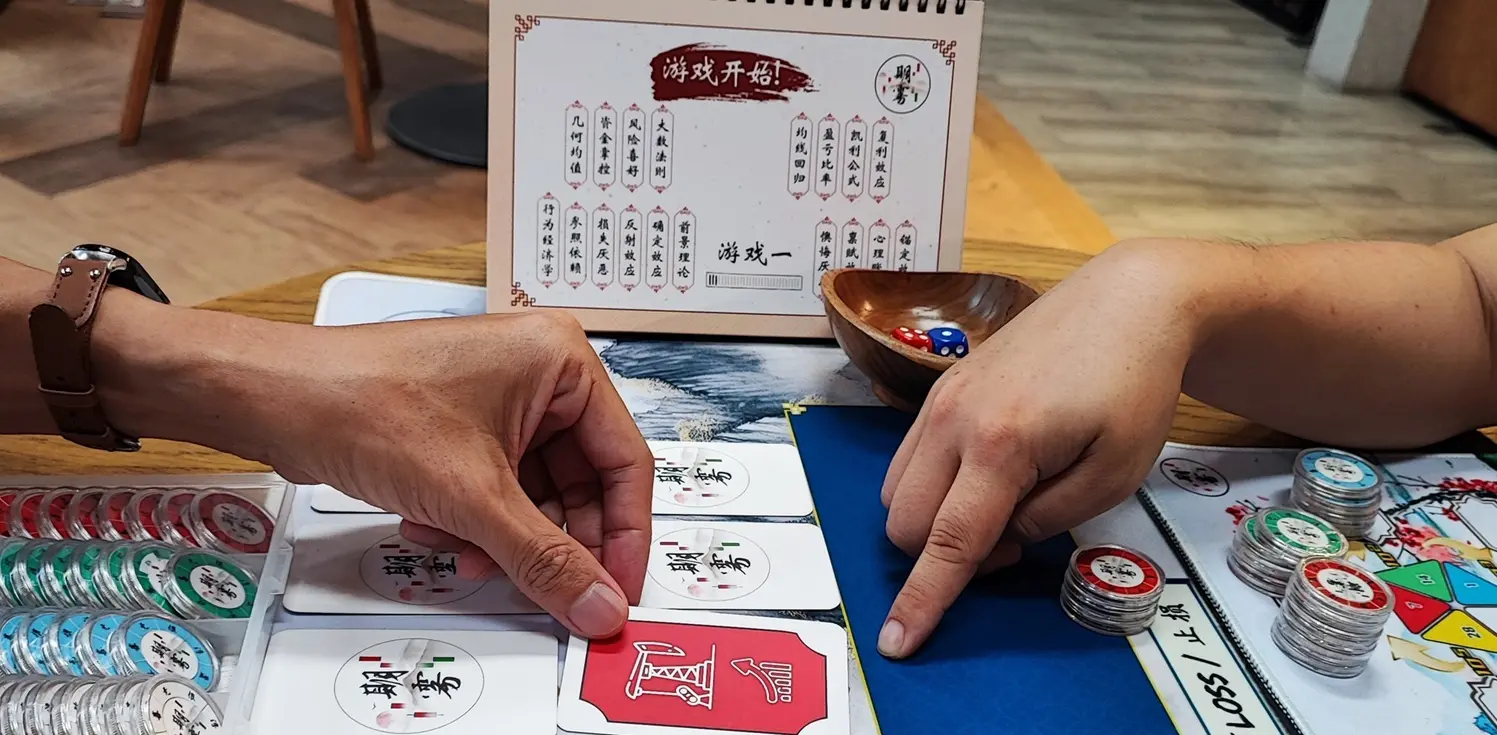
Method in action
Make uncertainty visible, comparable and discussable.
Cards, charts and probability devices turn an abstract sequence into a concrete experience. Every assumption, decision, result and drawdown leaves a path that can be reviewed.
Run the Experiment Again ↑Clear boundaries
Simulation describes possibilities. It does not promise outcomes.
The Probability Lab is designed to improve questions, not manufacture certainty.
The Lab explores
- Strategy assumptions and expected value
- Risk, sizing and drawdown
- Sequence variation and recovery
- Compounding under uncertainty
The Lab does not provide
- Guaranteed profit or fixed returns
- Predictions of the next trade
- Signals, execution or fund management
- A promise that capital will reach any target
The QIWU ecosystem
Market. Probability. Self.
Three connected systems answer three different questions behind an investment decision.
Questions, answered
Before entering the Lab.
Is the original “100K to 100M” name a profit promise?
No. It is the original name of a probability thought experiment. It does not represent a promise, forecast or guaranteed wealth outcome.
What does the Probability Lab study?
It studies how a method may behave across a long sequence when win rate, payoff ratio, risk per round, position sizing, result order, drawdown and compounding interact.
Does a higher win rate always produce a better result?
No. A high win rate can still be weakened by poor payoff ratios, oversized risk or an adverse sequence. Long-term performance depends on the relationship between variables.
Is this investment advice?
No. All simulation and analysis are for education, research and decision reference only. They do not predict actual market outcomes.
QIWU 02 · PROBABILITY
Do not ask only whether the next trade will win.
Ask what happens when the same method is repeated across a long and uncertain sequence.
Public preview available|Formal packages and paid services have not launched